The Ultimate Guide to Marketing for Startups in 2025: Your Roadmap to GCC Market Dominance
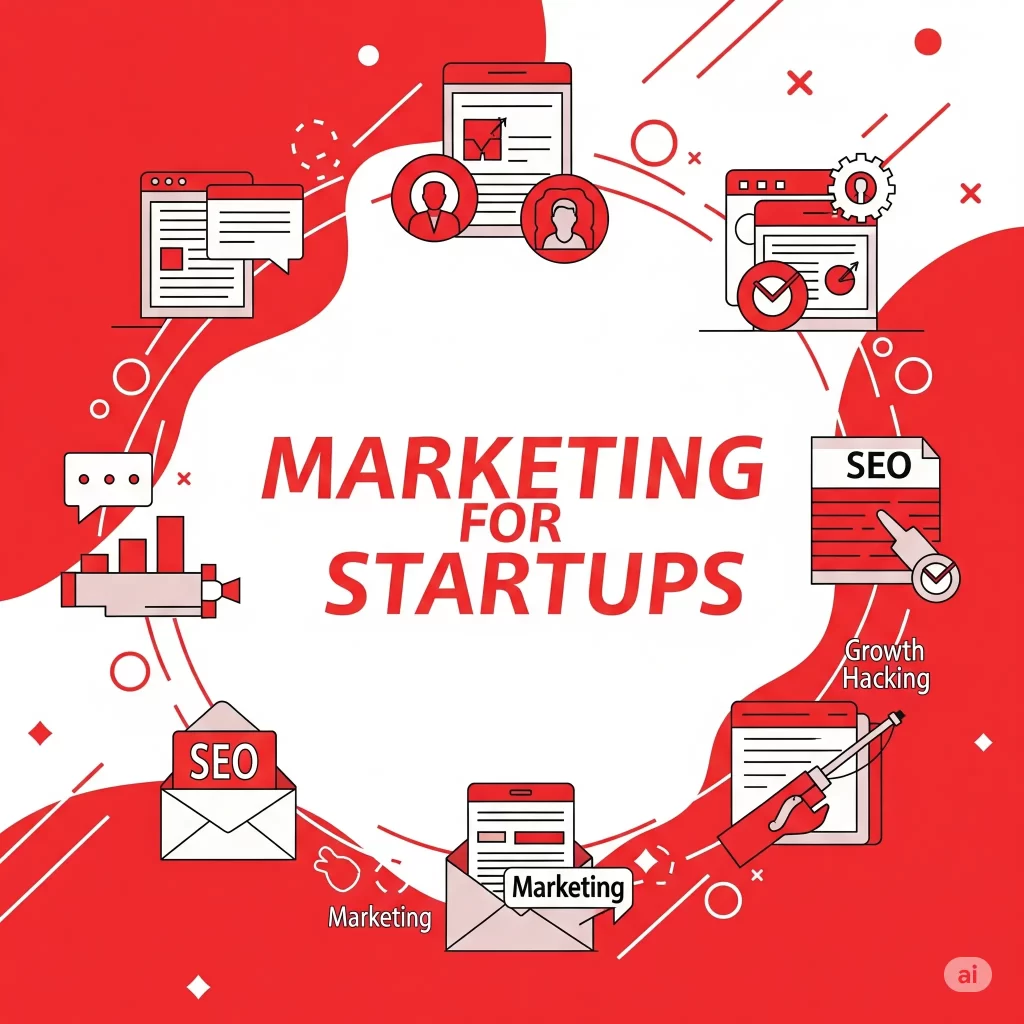
For any startup, the journey from a brilliant idea to a market-leading brand is paved with strategic marketing. In the dynamic and digitally-driven economies of the Gulf Cooperation Council (GCC), a powerful marketing for startups isn’t just an advantage; it’s the essential engine for growth, customer acquisition, and survival. This comprehensive guide is designed for the ambitious startup and SME leaders in regions like Saudi Arabia, the UAE, and Oman, providing a clear roadmap to navigate the complexities of modern digital marketing and build a brand that lasts.
This is more than a checklist; it’s a strategic framework. We will explore everything from lean, rapid-growth tactics to the foundational principles of building a sustainable online presence. Whether you’re allocating your first marketing budget or looking to scale your efforts, this guide will equip you with the knowledge to make data-driven decisions, attract your ideal customers, and achieve significant business growth.
The Core Pillars of a Marketing for Startups
A successful startup marketing plan is a multi-faceted ecosystem where different channels work in synergy. It’s about creating a powerful online presence that not only attracts attention but also builds trust and converts interest into revenue. Let’s dissect the essential components.
Growth Hacking: The Startup’s Accelerator
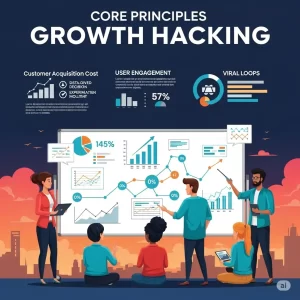
For startups operating with lean budgets and ambitious timelines, “growth hacking” is a critical mindset. It’s about using creative, low-cost, and data-driven tactics to acquire and retain customers rapidly. The focus is on experimentation across the entire customer funnel—from acquisition and activation to retention and referral.
While early examples of growth hacking involved clever “hacks” like Airbnb’s integration with Craigslist, the discipline has matured.[4] Today, it’s less about short-term tricks and more about building sustainable growth engines. This means leveraging strategies like referral marketing, optimizing for virality, and using SEO tactics designed for rapid impact.A key framework used is setting SMART (Specific, Measurable, Achievable, Relevant, Time-bound) goals to ensure every experiment is purposeful and its impact can be clearly measured.
Social Media Marketing for startups: Building Your Community and Brand
In today’s digital landscape, social media is an indispensable channel for startups. It offers a direct line of communication with customers, a platform for brand storytelling, and a cost-effective way to drive initial website traffic. However, success requires more than just posting content. A strategic approach is vital.
This starts with defining your ideal customer profile (ICP) and selecting the platforms where they are most active—be it LinkedIn for B2B engagement, Instagram for visual-driven brands, or TikTok for reaching a younger demographic. An effective content strategy, like the 80-20 rule (80% value-driven content, 20% promotional), ensures your feed informs and entertains, rather than just sells.[8] Furthermore, a sophisticated approach involves using keyword research within social platforms to enhance discoverability in profiles and posts, turning your social presence into a powerful acquisition tool.
SEO vs. SEM: Charting Your Course in Search
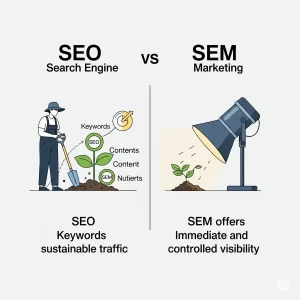
For any business, visibility on search engines like Google is paramount. This is achieved through two primary methods: Search Engine Optimization (SEO) and Search Engine Marketing (SEM). Understanding their differences is crucial for allocating your marketing budget effectively.
SEO (Search Engine Optimization) is the organic approach. It involves optimizing your website’s content and technical structure to rank higher in the unpaid search results. SEO is a long-term investment that builds trust and sustainable traffic. While the clicks are “free,” it requires a significant investment in time and resources to create high-quality content and build authority.
SEM (Search Engine Marketing) is often used to describe the paid approach, primarily Pay-Per-Click (PPC) advertising. With SEM, you bid on keywords to have your ads appear at the top of the search results page. This strategy delivers immediate traffic and is excellent for product launches or highly targeted campaigns. The downside is that your visibility stops the moment you stop paying.
A powerful strategy often involves using both. PPC can generate immediate data and traffic, which can inform your long-term SEO strategy, while strong SEO can reduce your reliance on paid ads over time.
Content Marketing for B2B: Building Trust and Authority
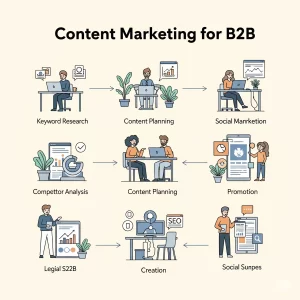 For B2B startups, the sales cycle is typically longer and involves multiple decision-makers. This is where content marketing shines. It’s a strategic approach focused on creating and distributing valuable, relevant content to attract and retain a business audience, establishing your company as a thought leader.
A successful B2B content strategy maps content to the different stages of the buyer’s journey (Marketing Funnel) :
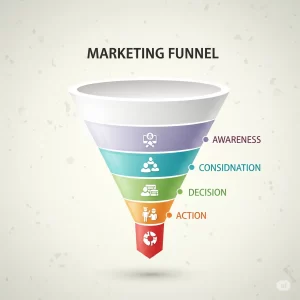 Top of Funnel (TOFU): Create awareness with educational blog posts, infographics, and industry reports (e.g., “What is Intelligent Automation?”).
Middle of Funnel (MOFU): Nurture leads with more specific content like case studies, whitepapers, and webinars that showcase your expertise.
Bottom of Funnel (BOFU): Drive conversions with product comparisons, demo requests, and detailed data sheets.
Distribution is just as important as creation. B2B content thrives on platforms like LinkedIn and through targeted email marketing campaigns.
Learn more about Digital Marketing Service from Qowwa
Executing Your Strategy: Frameworks and Channels
With the core components understood, the next step is to structure and execute your plan. This involves choosing the right frameworks and mastering the most effective channels for your business.
Go-To-Market (GTM) Strategy: Your Launch Blueprint
A Go-To-Market (GTM) strategy is a comprehensive action plan for launching a new product or entering a new market. It’s a critical framework for startups, ensuring that every aspect of the launch is aligned. A GTM strategy goes beyond marketing to include sales, pricing, and distribution.
Key steps in building a GTM strategy include:
Identify the Problem and Product-Market Fit: Clearly define the customer pain point your product solves.
Define Your Target Audience: Create detailed buyer personas based on market research.
Craft Your Value Proposition and Pricing: Articulate what makes your product unique and determine a sustainable pricing model.
Choose Sales and Marketing Channels: Decide on the most effective channels to reach your audience, from direct sales to digital advertising.
Set Success Metrics: Establish clear KPIs to measure the success of your launch.
The SOSTAC® Model: A Framework for Flawless Planning
The SOSTAC® model, developed by PR Smith, is a simple yet powerful framework for structuring any marketing plan.[22, 23] It provides a logical sequence to ensure all critical elements are considered:
Situation – Where are we now? (SWOT analysis, competitor analysis)
Objectives – Where do we want to be? (Set SMART goals, like “increase leads by 20% in Q3”)
Strategy – How do we get there? (The big picture, including segmentation and positioning)
Tactics – How exactly do we get there? (The specific marketing mix: SEO, email, social media, etc.)
Action – What is our plan? (Assigning responsibilities and creating timelines)
Control – Did we get there? (Tracking performance with analytics and KPIs)
Using SOSTAC® brings clarity and discipline to your marketing efforts, transforming ambitious goals into an actionable plan.
Mastering Key Channels: Paid Ads and LinkedIn
While many channels exist, paid advertising and LinkedIn marketing are particularly vital for many startups.
Paid Ads (PPC): Platforms like Google Ads offer startups a way to gain immediate visibility and drive highly targeted traffic. Success hinges on meticulous keyword research, focusing on high-intent terms that signal a user is ready to buy.Crafting compelling ad copy that highlights benefits and creating optimized landing pages are essential for converting clicks into customers. A starting budget of $20-$50 per day can be enough to gather initial data and test campaigns.
LinkedIn Marketing: For B2B startups, LinkedIn is the most important professional network for lead generation and building thought leadership. An effective strategy involves more than just posting updates. It requires optimizing your company page with relevant keywords, publishing valuable long-form articles, engaging in relevant groups, and leveraging targeted LinkedIn Ads to reach specific job titles and industries. With 89% of B2B marketers using it for lead generation, mastering LinkedIn is non-negotiable.
Conclusion: Your Partner in Growth
Embarking on a marketing journey as a startup can feel daunting, but it is the most critical driver of your success. By understanding the core principles of growth hacking, social media, search marketing, and content, and by applying structured frameworks like GTM and SOSTAC®, you can build a formidable marketing engine. The key is to be strategic, data-driven, and relentlessly focused on providing value to your target audience.
This guide provides the map, but the journey requires execution and expertise. At Qowwa, we specialize in transforming these strategies into tangible results for startups and SMEs across the GCC. If you’re ready to build a marketing strategy that drives real growth, we invite you to get a free consultation and let us be your partner in success.